


La Digue Travel Guide
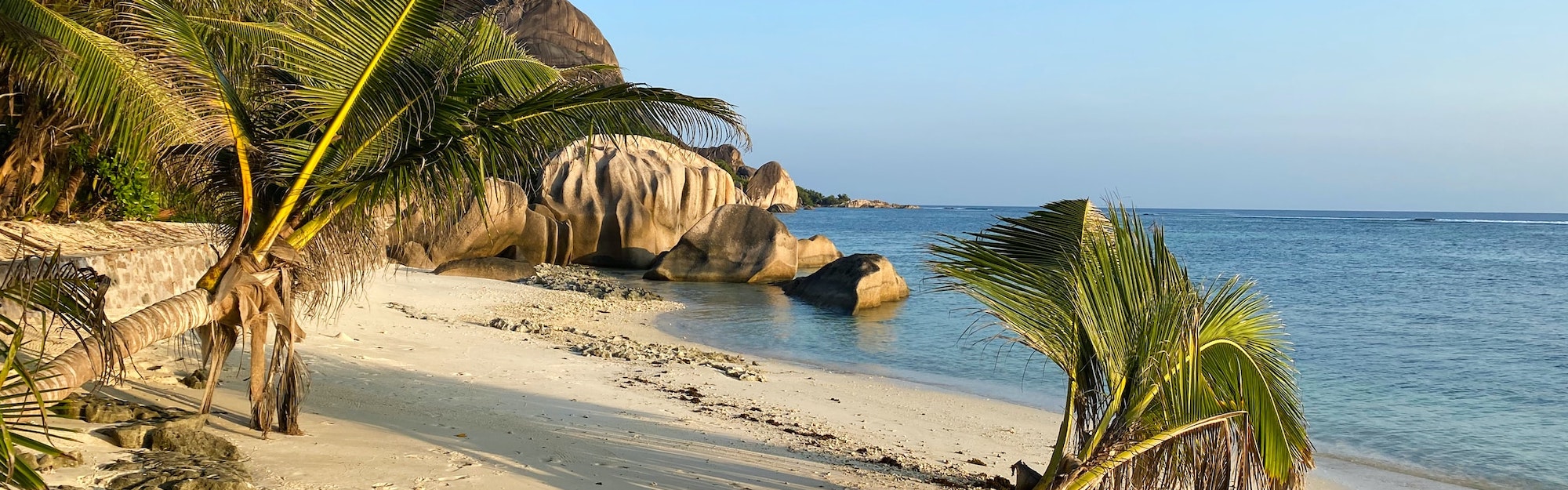
With perfect sandy beaches, tangled jungles and swaying palm trees, La Digue Island is the epitome of a tropical island getaway. A few minutes east of Praslin by boat, La Digue is the fourth largest of the Seychelles' inhabited islands, with a population of around 3,000 people and an area of roughly four square miles (10 sq km).
Though it is a popular Seychelles holiday destination, La Digue Island has managed to avoid the enthusiastic tourist development that threatens some areas of Praslin and Mahé. La Passe is the only real settlement on the island, with a small casino and a quaint jetty where both rickety fishing boats and sleek yachts moor.
Life on La Digue clings to Creole traditions more than other islands, and tourists can buy fresh fish direct from quayside fisherman, play dominoes late into the night at local bars, or accompany residents to Mass wearing their Sunday best. The laid-back feel of the island is captured by the main mode of transportation, the slow-moving ox cart.
Urban life is only a small part of a holiday on La Digue Island; 40 percent of the island is devoted to nature reserves, enjoying the protection of National Park status. Most of the island's population lives on the low eastern plateau, with the rest given over to local flora and fauna such as the Seychelles Paradise Flycatcher and the Aldabra Giant Tortoise.
As far as beaches on La Digue Island go, Anse Source d'Argent is by far the most popular. Voted among the top beaches in the world on more than one occasion, Anse Source d'Argent is still only one of many beautiful beaches on La Digue.
Outdoor activities abound on La Digue, and visitors can enjoy climbing Eagle's Nest Mountain, taking bicycle tours of the jungle or horseback riding on the L'Union Estate.
Seychelles travel info
Electricity
Electrical current is 220-240 volts, 50Hz. Plugs are of the British type, with three flat pins.
Language
Creole, English and French are all spoken in the Seychelles.
Money
The Seychelles currency is the rupee (SCR), which is divided into 100 cents. It's uncommon to buy goods or pay for services in any other currency, though some guesthouses and hotels may accept euros or US dollars. Credit cards are widely welcomed throughout the Seychelles, and ATMs are available at major banks in Victoria and Praslin. Money can be exchanged at travel agents, banks and bureau de changes.
Tipping
Tipping generally isn't practiced and is never expected in the Seychelles, though top-end hotels or restaurants will sometimes add a service charge of 10 to 15 percent to the bill.
Health
Health regulations in the Seychelles require that travellers who arrive from or have transited through areas where there is a risk of yellow fever transmission have a vaccination certificate. All eligible travellers should be up to date with their COVID-19 vaccines; immunisation against hepatitis A, hepatitis B and typhoid are recommended. Visitors are advised to bring their own medication to avert the risk of travellers' diarrhoea, as well as sun block and insect repellent, as local supplies can be erratic and costly. During the rainy season in particular, visitors should take precautions against mosquito bites due to the risk of dengue fever and the chikungunya virus (although these diseases are rare in Seychelles). Tap water meets WHO standards, but most visitors prefer to drink bottled water, which is widely available. Medical facilities on the more remote islands are limited or non-existent, but visitors will find a government hospital and several private clinics in Victoria. Medical insurance with full evacuation cover is necessary.
Safety
Safety is not generally an issue in the Seychelles; violent crime is unlikely and most visits are trouble free. There have been some incidents of theft and assault, but these are targeted mainly at residents. Visitors should be vigilant, particularly after dark in Victoria and in isolated areas, and should avoid taking valuables to the beach, where petty thieves might snatch them. Women should avoid walking alone on isolated beaches.
Local customs
Seychellois are usually described as laid-back and easygoing, and dress codes around the destination are generally relaxed. Nudism is unacceptable, however, and topless bathing is tolerated on very few beaches. Punishments for drug offences can be severe.
Doing business
In the Seychelles, business is conducted relatively informally. Men and women are not required to wear formal suits, although a smart appearance is advised. Business is usually conducted in English or French. Business hours are generally 8am to 4pm Monday to Friday.
Duty free
Travellers to the Seychelles over 18 years do not have to pay duty on 200 cigarettes, or 250g of tobacco; two litres of spirits and two litres of wine; 200ml of perfume or eau de toilette. Prohibited items include drugs, narcotics, firearms, spear-fishing equipment, and camouflage clothing.
Communications
The international dialling code for Seychelles is +248. The outgoing code is 00 followed by the relevant country code (e.g. 0044 for the United Kingdom). Visitors can purchase local SIM cards for their mobile phones and many midrange and all top-end hotels offer WiFi, as do some cafes and restaurants.
Passport & Visa
No foreigners require a visa to enter Seychelles. A visitor's permit, valid for a maximum of three month, is issued on arrival and may be extended on application for up to three months. All visitors do, however, require a passport valid for the duration of their visit, a return or onward ticket, sufficient funds to cover their stay (a minimum of USD 150 per day), and proof of accommodation. Extensions are possible if applied for at least a week before expiry of visitor's permit. It is highly recommended that travellers' passports have at least six months' validity remaining after the intended date of departure from their travel destination. Immigration officials often apply different rules to those stated by travel agents and official sources.
Entry requirements
United States citizens require a passport valid for at least the length of their stay and will be issued with a visitor's permit on arrival, valid for three months. A visa is required.
British citizens need a passport valid for the duration of their stay, and will be issued with a visitor's permit on arrival, valid for three months. A visa is required.
Canadians require a passport valid for at least the length of their stay and will be issued with a visitor's permit on arrival, valid for three months. A visa is required.
Australians need a passport valid for the length of their stay and will be issued with a visitor's permit on arrival, valid for three months. A visa is required.
South Africans must have a passport valid for the duration of their stay and will be issued with a visitor's permit on arrival, valid for three months. A visa is required.
Irish citizens require a passport valid for the length of their stay and will be issued with a visitor's permit on arrival, valid for three months. A visa is required.
New Zealand citizens require a passport valid for the length of their stay and will be issued with a visitor's permit on arrival, valid for three months. A visa is required.
Useful contacts
Seychelles Tourist Office, Mahe: www.seychelles.travel/en/
999 (police and rescue services); 151 (medical emergency).