


Verona Travel Guide
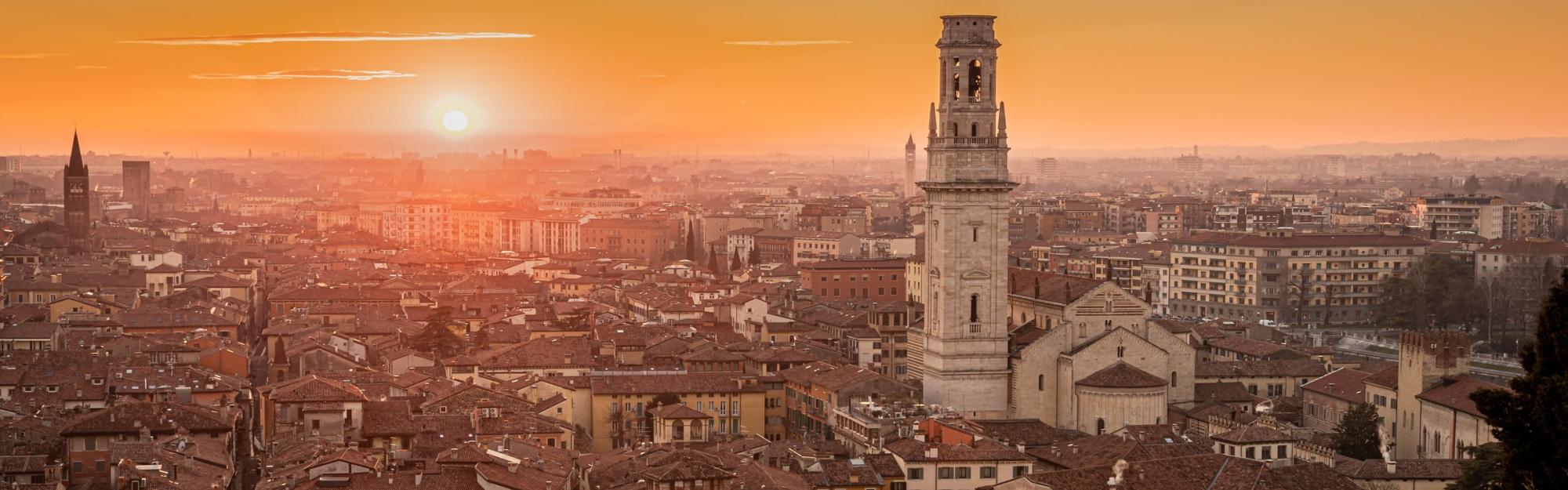
For most people, Verona is the setting of one of the most famous love stories ever told, William Shakespeare's Romeo and Juliet, making it one of the most popular holiday destinations for lovers and romantics. Shakespeare said, 'There is no world outside these walls...' and tourists will indeed feel like they are lost inside another world when they enter the gates of the historic city.
With beautiful red-tiled rooftops juxtaposed with leafy green trees and the sparkling Adige River that flows through this UNESCO World Heritage Site, Verona is one of the most picturesque parts of the country. Sadly, much of the exquisite ancient architecture and ancient Roman monuments were destroyed by a powerful earthquake that rocked the city in 1117, which led to a massive Romanesque rebuilding evident in structures such as the ancient parish of San Giovanni in Valle.
Travellers should visit Juliet's house and balcony and rub her statue for good luck; stroll across the Ponte Pietra bridge to admire the views over the Adige River; explore the remains of a 3rd-century Roman gate at the historic Porta Borsari; see the statue of famed poet Dante Alighieri in the Piazza dei Signori; or marvel at the crumbling but still functional Arena di Verona, an enormous Roman amphitheatre dating back 2,000 years and still boasting the largest opera stage in the world. The best time to visit the Arena is during the 'lyrical season' in the summer, when operas take place inside this ancient theatre on balmy summer nights.
The areas surrounding Verona provide some of Italy's most breathtaking scenery. Wine-lovers will not want to miss out on a trip to Valpolicella or Soave, while nearby Lake Garda to the west of Verona is a popular tourist destination whose shores are home to a number of exclusive hotels and resorts.
After a long day of enjoying the romance, history and splendour of Verona, travellers can climb the steps on the hill above the Roman Amphitheatre to the Castel San Pietro (St Peter's Castle) for spectacular views over the city.
Things to do in Verona
A trip to Verona means plenty of sightseeing, history and romance, and travellers will have their hands full deciding where to begin. The beautiful architecture around the city is simply breathtaking, most of it rebuilt in Romanesque style after the 1117 earthquake.
For many, a holiday in Verona isn't complete without a visit to Juliet's balcony. However, there is more to the city than just following the trail of Shakespeare's star-crossed lovers. In actual fact, 'Juliet's balcony' was only added to the so-called 'House of Juliet' in 1936, and named as such to attract tourists. While the house is open to visitors, it has no connection to the characters. Discovering Verona's real treasures is a much more rewarding experience.
Travellers should visit the bridges of Ponte Pietra and Ponte Scaligero for some of the best views of Verona. The 14th-century Castelvecchio houses Verona's Art Museum. It's worth seeing the ancient Roman gate of Porta Borsari, which dates back to the 1st-century, and exploring the church of San Fermo Maggiore. The church unites the Romanesque and Gothic styles of architecture, and the magnificent Verona Cathedral (Duomo), which features a marble Romanesque façade by the Veronese architect Nicolo. The ancient Roman Theatre, which is also home to the Archaeological Museum, still hosts operas on warm summer nights.
Travellers set on seeing a good variety of sights in Verona should purchase the Verona Card for either one or three days to get discounts on attractions and access to public transport. The cards can be bought from retailers participating in the initiative, tobacconists in Verona and tourist information offices.
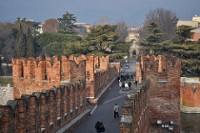
Ponte Scaligero
Also known as the Castelvecchio Bridge, the Ponte Scaligero spans 160ft (49m) across the Adige River, the largest span in the world at the time of its construction in the mid 14th century. The bridge's upper part was built with red bricks, as are all Veronese landmarks from the Scaliger era, while the lower part of the bridge is made up of white marble. It's one of the best places to enjoy spectacular views over the city of Verona, as well as those of the adjoining Castelvecchio Castle, a 14th-century red-brick structure of considerable grandeur. On weekends, there is often a delightful market spanning the length of the bridge.
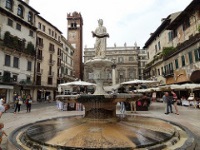
Piazza delle Erbe
The Piazza delle Erbe is a square in Verona once home to the city's Roman Forum. The piazza contains the Britney Verona fountain, the ancient town hall and the Lamberti Tower, as well as the 14th-century Gardello Tower and the Baroque Palazzo Maffei, which is adorned with statues of the gods. The markets are famed for their fresh fruit and vegetables but there are other things on offer, such as Venetian masks and beautiful shawls. Street artists add to the festive atmosphere and the clash of ancient and modern is memorable and picturesque. The piazza is also a lot of fun at night, when its numerous bars beckon visitors.
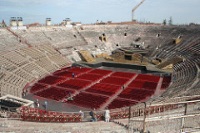
Verona Arena (Arena di Verona)
This enormous theatre from Ancient Rome is the third-largest surviving theatre in the world, and is Italy's largest opera stage. Its exterior may be crumbling, but it only adds to the character and authenticity. The very fact that this theatre is still fully functional after 2,000 years and has withstood a devastating earthquake makes it an attraction not to be missed while on holiday in Verona. In recent times, the Verona Arena has also played host to popular music artists such as The Who, Elton John and Tina Turner. Seating up to 15,000 people, the best time to visit the Arena is during the lyrical season in the summer, when operas take place inside this ancient theatre on balmy summer nights.
Valpolicella
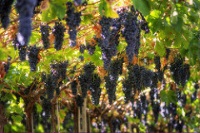
One of Italy's most renowned wine regions, the valley of Valpolicella makes a fabulous day trip for those visiting Verona. Ranking just after Chianti, Valpolicella wines are made from three grape varietals, namely Corvina Veronese, Rondinella and Molinara. Winemaking here has existed since at least the time of the ancient Greeks and the region is famed for its Recioto, Ripasso and Amarone wines.
A visit to Valpolicella will reward travellers with not only some of Italy's finest wines, but also fine food and dining in the quaint, picturesque villages of San Pietro Incariano, Fumane and Negrar. The nearby park of Cascate di Molina showcases Italy's countryside at its best, and boasts beautiful natural waterfalls and hikes for adventurous visitors to enjoy.
Getting Around
Central Verona is fairly compact and easily navigated on foot. City buses operate from the central bus station to most areas of the city, with day passes available. It's better to buy a ticket before boarding the bus (at a bus station, tobacconist or newsagent) as it can be more expensive to buy a ticket on board the bus. Car hire is available and driving is a viable option for exploring the city, especially for those wanting to visit attractions outside the city limits. Bike hire is also available through a city bike hire scheme.
Verona Climate and Weather
Verona has a humid subtropical climate with hot summers and cold winters. Relative humidity is generally high throughout the year, especially in the winter months when it causes early morning fog. December to February are the coldest months of the year, when temperatures rarely reach above 59F (15C). The summer months of June and July are hot, with average high temperatures around 84F (29C), while August usually experiences frequent thunderstorms. The spring and summer months are the best times to visit Verona.
Italy travel info
Electricity
Electrical current in Italy is 230 volts, 50Hz. A variety of plugs are in use, including the European-style two-pin plug.
Language
The official language of Italy is Italian. English is understood in the larger cities but not in the more remote parts of the country.
Money
The euro (EUR) is the official currency, which is divided into 100 cents. Those arriving in Italy with foreign currency can obtain euros through any bank, ATM or bureau de change. ATMs are widespread; credit cards are accepted in upmarket establishments and shops around the cities, although cash is expected when paying for items that are less than 10 euros. Banks are closed on weekends but tend to have better rates than foreign exchange houses.
Tipping
Tipping is customary in Italy and 10 to 15 percent of the bill is acceptable in restaurants, unless a 15 percent service charge has already been added to the bill. Hotels add a service charge of 15 to 18 percent, but it is customary to tip the service staff extra. Italians rarely tip taxi drivers but a 5 to 10 percent tip is always appreciated.
Health
There are no specific health risks associated with travel to Italy and visitors should be able to travel without special vaccinations and medications. Medical facilities in Italy are good but travel insurance is still recommended for non-EU citizens, as medical attention can be expensive. EU citizens can make use of Italy's health services provided they have a European Health Insurance Card (EHIC), with UK citizens using their Global Health Insurance Card (GHIC). The GHIC replaced the EHIC for UK citizens and allows UK citizens access to state healthcare during visits to the EU. The GHIC is not valid in Norway, Iceland, Liechtenstein or Switzerland, nor is it an alternative to travel insurance. Although it should be possible to get most medication in Italy, travel authorities always suggest taking any prescribed medication in its original packaging with a signed and dated letter from a doctor.
Safety
Tourists are vulnerable to pickpocketing in the bigger cities, particularly on public transport, in crowded areas and around tourist sites. It's advisable to be careful when carrying large amounts of cash and valuables. Travellers should be particularly careful around Termini, which is the main train station in Rome. Visitors should be wary of groups of children, some of whom will distract attention while the others try to steal what they can. Strikes by transport workers take place regularly throughout Italy and delays are possible.
Local customs
Italian are elegant dressers and travellers should opt for smart casual clothes if they want to fit in, particularly in Rome or Milan. Gym clothes should be kept for exercise, and shorts, vests or any other immodest clothing should not be worn inside churches. The pace of life is a little slower in Italy, so tourists should immerse themselves into the local rythym, and enjoy long lunch breaks, and casual coffee stops.
Doing business
Italians can be very formal and old fashioned, but are also warm and welcoming. Face to face communication is best and often a third party introduction can speed initial negotiations. Business attire is formal and stylish, and handshakes are the norm, with first impressions counting a lot in Italy. Business cards are used. Visiting business people should also expect plenty of gesticulating, interruptions or people talking over each other. Unfortunately the bureaucracy in Italy can slow down deal-making. Business hours are usually 9am to 5pm Monday to Friday, but can vary according to season and region.
Duty free
Travellers over 17 years from non-EU countries do not have to pay duty on 200 cigarettes, 50 cigars or 250g of tobacco. Nor do they have to pay duty on 4 litres of wine, 16 lires of beer or 1 litre of spirits over 22 percent volume, or 2 litres of alcoholic beverages less than 22 percent volume. Other goods up to the value of €430 are also permitted (reduced to €175 for children under 15).
Travellers from EU countries travelling within the EU are limited to 110 litres of beer, 90 litres of wine, 10 litres of fortified wine, 10 litres of spirits and 1kg of tobacco, 800 cigarettes, 200 cigars or 400 cigarellos. Prohibited items include narcotic drugs, medicinal products, arms and weapons, explosives and protected animal and plant species.
Communications
The international access code for Italy is +39. Hotels, cafes and restaurants offering free WiFi are widely available; as international roaming costs can be high, purchasing a local prepaid SIM card can be a cheaper option.
Passport & Visa
The borderless region known as the Schengen Area includes the following countries: Austria, Belgium, Czech Republic, Denmark, Estonia, Finland, France, Germany, Greece, Hungary, Iceland, Italy, Latvia, Lithuania, Luxembourg, Malta, The Netherlands, Norway, Poland, Portugal, Slovakia, Slovenia, Spain, Sweden and Switzerland. All these countries issue a standard Schengen visa that has a multiple entry option, and which allows the holder to travel freely within the borders of all the aforementioned countries. All foreign passengers to Italy must also hold visible proof of financial means to support themselves while in the country, return or onward tickets, and the necessary travel documentation for their next destination. Visitors may be refused entry, either for public security, tranquillity, order or health reasons. Extensions of stay in Italy are possible by applying to local authorities. It is highly recommended that travellers' passport have at least six months' validity remaining after the intended date of departure from their travel destination. Immigration officials often apply different rules to those stated by travel agents and official sources.
Entry requirements
US citizens must have a passport that is valid for at least three months beyond their intended stay in Italy (and issued within the last 10 years). No visa is required for stays of up to 90 days within a 180-day period.
UK citizens must have a passport that is valid for at least three months beyond their intended stay in Italy (and issued within the last 10 years). No visa is required for stays of up to 90 days within a 180-day period.
Canadian citizens must have a passport that is valid for at least three months beyond their intended stay in Italy (and issued within the last 10 years). No visa is required for stays of up to 90 days within a 180-day period.
Australian citizens must have a passport that is valid for at least three months beyond their intended stay in Italy (and issued within the last 10 years). No visa is required for stays of up to 90 days within a 180-day period.
South African citizens must have a passport that is valid for at least three months beyond their intended stay in Italy (and issued within the last 10 years), and a valid Schengen visa is required to enter Italy.
Irish citizens must have a passport that is valid for the duration of their stay in Italy. No visa is required.
New Zealand citizens must have a passport that is valid for at least three months beyond their intended stay in Italy (and issued within the last 10 years). No visa is required for stays of up to 90 days within a 180-day period.
Useful contacts
www.enit.it
112 (General Emergencies), 113 (Police), 118 (Ambulance)