

Country guides
 Africa
Tanzania is one of the largest countries in East Africa and an absolute jewel of a destination. Home to Africa's highest peak (Mount Kilimanjaro), its lowest depression (the bed of Lake Tanganyika), its most famous national park (the Serengeti), and part of its largest lake by area (Lake Victoria), its natural wonders attract visitors from all over the globe.
Travellers generally visit to enjoy one or more of Tanzania's four famous travel experiences, the first of which is a sun-soaked getaway to the island paradise of Zanzibar for an exotic beach holiday capped by a fascinating visit to the historic, UNESCO-listed Stone Town.
Alternatively, visitors can go on a snorkelling and diving holiday in the Spice Islands, with Mafia Island being the standout in this charming selection of destinations. Travellers will find a gorgeous coral reef system, the opportunity to swim with whale sharks, a rich cultural heritage and a quieter, more untouched feel than on other islands in the group.
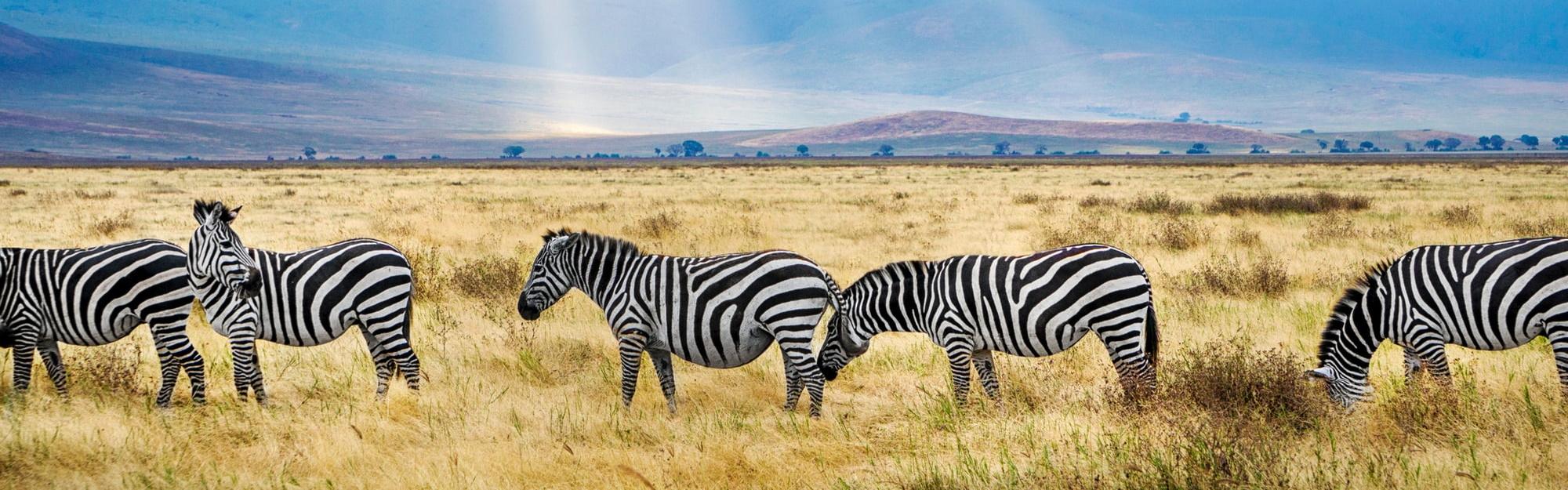
Visitors can also enjoy safari tours of Tanzania's world-famous game and wildlife parks, particularly the magnificent Serengeti National Park, which annually plays host to the largest mammal migration in the world. Last but by no means least, travellers can visit Mount Kilimanjaro National Park, and the brave can attempt to summit the mighty peak, which rises out of lush rainforest.
Best time to visit Tanzania
Tanzania's climate is characterised by distinct wet and dry seasons. Tanzania has two rainy seasons: the 'Mango Rains' last from November to mid-January, and the chief monsoon season runs from mid-March to May. The best time to visit is between June and August, when daytime temperatures are bearable, and nights are cool rather than sultry. For visitors to the Serengeti, the famous migration starts in late February. However, visitors should be warned that this is an extremely hot time of the year, with the mercury rising as high as 90ºF (32ºC).
What to see in Tanzania
-Stone Town's Anglican Cathedral is a must for those interested in African history.
-Travellers can laze on one of Zanzibar's famed northern beaches such as Kendwa and Matemwe, while watching picturesque dhow boats sail by.
-The Makumbusho Village Museum in Dar es Salaam offers visitors the interesting opportunity to view traditional Tanzanian tribal homes.
-The Central Market in Stone Town is a vibrant place full of sights, smells, and sounds that will linger long in the memory.
What to do in Tanzania
-Go scuba diving in the Spice Islands, at popular dive sites around the Mafia and Pemba Islands.
-Go on safari in the Serengeti and see the world-famous mammal migration, with more than one million wildebeest making the epic northward trip.
-Ramble around Zanzibar's historic Stone Town district, and admire the gorgeous buildings and colourful bazaars that line the maze-like streets.
-Travel to Mount Kilimanjaro National Park and attempt a hike up Africa's highest summit.
Getting to Tanzania
Flights to Tanzania are available from a variety of European and Middle Eastern destinations. The flight to Julius Nyerere International Airport in Dar es Salaam takes about 12 hours from major British airports. American and British travellers will usually have to book an indirect flight to Tanzania, stopping over in Amsterdam.
Read
The Book of Secrets by MG Vassanji, The Snows of Mount Kilimanjaro by Ernest Hemingway, Great Sky Woman by Steven Barnes, and Shout at the Devil by Wilbur Smith.
Watch
The African Queen (1951) and Darwin's Nightmare (2004).
Eat
Mtori (cooked beef, prepared with bananas), mchicha (a vegetable-based stew with meat or fish added to it), and ugali (a polenta-style side dish made from corn flour).
Drink
Konyagi, an alcoholic beverage somewhere between gin and vodka.
What to buy
Beaded African jewellery, carved soapstone figurines, Masai blankets and Tingatinga artworks.
What to pack
It's important to pack sunscreen, lightweight clothing, after-sun lotion, and effective insect repellent for a holiday in Tanzania. Travellers should remember that Tanzania is a predominately Muslim country and that modest dress is required, no matter the heat. If travellers are planning to climb Mount Kilimanjaro, they shouldn't make the mistake of starting the hike in brand-new shoes.
What's on in Tanzania
The TanzaCat Catamaran Regatta in September is popular among sailing enthusiasts, with thousands of foreign visitors making their way to Dar es Salaam's Msasani Bay. East Africa's top music festival, Sauti za Busara ('sounds of wisdom' in Swahili) is a celebration of African music, with hundreds of artists performing across four days in February turning Stone Town into a vibrant party scene.
Did you know?
-The Great African Rift Valley, one of Tanzania's chief geological features, is visible from space.
-The name Tanzania is a portmanteau of Tanganyika and Zanzibar.
-The coconut crab, found on Zanzibar, is one of the largest crabs in the world.
A final word
A land overflowing with natural sights and wonders, Tanzania offers visitors a selection of unforgettable holiday experiences ranging from the swaying coconut palms of a Zanzibar beach to the action-packed wildebeest migrations on a Serengeti safari.
Things to do in Tanzania
Synonymous with the Serengeti and the tropical island of Zanzibar, Tanzania is an eco-tourist's dream, a bucket-list destination for wildlife safaris, and an idyllic beach getaway all in one. Wonderful game-viewing opportunities abound in Tanzania and the most popular parks include the Mount Kilimanjaro Game Park and the Serengeti National Park.
The former is most commonly visited by travellers keen to summit the famous Kilimanjaro, a magnificent hike which is surprisingly easy considering the height of the mountain, but should certainly not be attempted without training and planning. The Serengeti National Park, on the other hand, is a prime safari destination, its crowning jewel the annual wildebeest migration, which qualifies as one of the natural wonders of the world.
Off the shore of mainland Africa, Zanzibar is known for crystalline turquoise waters and sandy white beaches on its north shore. Apart from the glorious beaches, resort attractions, and water sports, the mysterious Stone Town intrigues visitors on Zanzibar with its UNESCO-listed melange of 19th-century Swahili, Arab, Indian, and European influences.
The quickest and most comfortable way to travel round this magical country is to fly between cities but, for the more rural areas and game parks, it's advisable to hire a car (preferably a 4x4) or join a tour. For those on a budget, taking the bus is the cheapest and easiest way to travel, but the accident rate is high due to bad roads and overloaded vehicles, so caution should be exercised.
Tanzania travel info
Electricity
The electrical current 230 volts, 50Hz. Rectangular or round three-pin plugs are used.
Language
Swahili and English are the official languages, though several indigenous languages are also spoken.
Money
The official currency is the Tanzanian shilling (TZS), which is divided into 100 cents. The tourism industry prices everything in US dollars and this is the preferred unit of currency for hotels, lodges, resorts, safaris, national parks and attractions, guides and tours, as well as high-end restaurants. Money can be exchanged in larger towns; foreign exchange bureaux may offer a better rate of exchange than banks.
Major cities have ATMs that accept foreign debit cards and issue Tanzanian shillings, though they sometimes break down or run out of money. To minimise the risk of card cloning, travellers should use ATMs located in banks, shops, hotels and shopping centres rather than on the street.
Major lodges, some hotels and travel agents in urban areas accept credit cards, but these shouldn't be relied on and can incur a surcharge. International digital wallet services such as Apple Pay and Google Pay are still relatively limited in their availability, especially for everyday transactions.
Tipping
Waiters in the better restaurants should be tipped around 10 percent; guides, porters and cooks in the wildlife parks and on safari trips usually receive tips as well. The amount is discretionary according to the standard of service and the number of people in the travelling party.
Health
Visitors should consider vaccinations for hepatitis A, hepatitis B, typhoid, and polio, and proof of yellow fever vaccination is required if visitors are coming from or have transited through an airport of a country where yellow fever occurs. There's a risk of malaria all year and outbreaks of Rift Valley Fever occur; travellers should take precautions to avoid mosquito bites and take malaria medication.
Food prepared by unlicensed vendors should be avoided, as meat and milk products from animals may not have been cooked thoroughly. Sleeping sickness is a risk in the game parks, including the Serengeti, and visitors should take precautions against bites by tsetse flies.
There's a high prevalence of HIV/Aids; cholera outbreaks are common throughout the country and visitors are advised to drink bottled or sterilised water only. Travellers climbing Mount Kilimanjaro are at risk for altitude sickness.
Medical services are available in Dar-es-Salaam and other main towns, but facilities and supplies are limited even in cities and often non-existent in rural areas. Visitors with particular requirements should take their own medicines. Comprehensive travel insurance is advised.
Safety
Most visits to Tanzania are trouble free, but violent and armed crime does exist. Travellers are sometimes the victims of mugging and bag snatching (especially by passing cars or motorbikes), and armed robbery and burglary rates have increased throughout the country. Travellers should avoid walking and cycling at night, and should walk towards the traffic so they can see the vehicles approaching. They should also avoid carrying large amounts of cash or other valuables, and leave their passport in the hotel safe.
As in other East African countries, there's some threat of terrorism in Tanzania, and visitors should be cautious in public places and at tourist sites. The areas bordering Burundi, the Democratic Republic of Congo and with Mozambique in the Mtwara region should also be avoided.
Road accidents are common due to poor road and vehicle conditions, violation of traffic regulations and exhaustion among long-distance drivers. There have also been a number of ferry accidents in Tanzania in recent years. Travellers should take precautions, such as staying away from buses or ferries that seem overloaded or in poor condition.
Local customs
Tanzanians are known to be friendly and are generally welcoming, but travellers should be sensitive to local cultural mores. Drunkenness is frowned upon and Tanzanians feel strongly about showing respect for their elders.
Visitors to Zanzibar should be aware that it's a predominantly Muslim region and visitors should dress modestly and respectfully. Beachwear is fine on the beach or around a hotel pool, but not acceptable elsewhere. Topless sunbathing is a criminal offence. Some tourists buy a local sarong, called a kanga, which can be used to cover shoulders when needed, or otherwise be used as a towel.
Smoking in public places is illegal; tourists should be especially careful during Ramadan, when public drinking, smoking and even eating in public should be avoided. Homosexuality is illegal.
Doing business
Although Tanzanians come across as relaxed and friendly, it's important to observe certain formalities, especially with greetings. It's advisable to learn a few Swahili phrases when greeting, followed by a handshake.
Women and men rarely shake hands in Swahili culture; however, if the woman extends her hand, the man is obliged to take it. Tanzanians are to be addressed as Mr, Mrs, and Ms, followed by the family name.
Business dress is seldom very formal but lightweight suits are recommended for formal occasions. Business hours are similar to Western countries, but a longer lunch break is taken during the hotter months, and business continues later in the evening from Monday to Friday.
Duty free
Travellers to Tanzania do not have to pay duty on 250g tobacco, 200 cigarettes or 50 cigars, and one litre of whisky and liquors or two litres of wine.
Communications
The international country dialling code for Tanzania, as well as Zanzibar, is +255. There's good mobile phone coverage in main cities and towns, while rural areas may have limited coverage. There are international roaming agreements with most international operators. WiFi is available in main towns and resorts; visitors can purchase local prepaid SIM cards for unlocked phones or use eSIMs if their cellular providers support it on their networks.
Passport & Visa
All visitors to Tanzania require proof of sufficient funds and should hold documentation for their return or onward journey. Passports should be valid for at least six months from date of entry. Most visitors entering will require a visa as well. Those arriving from an infected country must hold a yellow fever vaccination certificate. It's highly recommended that travellers' passports have at least six months' validity remaining after the intended date of departure from their travel destination. Immigration officials often apply different rules to those stated by travel agents and official sources.
Entry requirements
US passports must be valid for six months from the date of entry. Travellers will need to apply for an eVisa before visiting Tanzania.
UK passports must be valid for six months from the date of entry. Travellers will need to apply for an eVisa before visiting Tanzania.
Canadian passports must be valid for six months from the date of entry. Travellers will need to apply for an eVisa before visiting Tanzania.
Australian passports must be valid for six months from the date of entry. Travellers will need to apply for an eVisa before visiting Tanzania.
South Africans do not require a visa if intending to stay for a maximum of up to 90 days, provided that the passport is valid for six months from date of entry.
Irish passports must be valid for six months from the date of entry. Travellers will need to apply for an eVisa before visiting Tanzania.
New Zealand passports must be valid for six months from the date of entry. Travellers will need to apply for an eVisa before visiting Tanzania.
Useful contacts
Tanzanian Tourist Office: www.tanzaniatourism.go.tz
112 (General)Climate in Tanzania
Tanzania is hot throughout the year and is humid on the coast and dry on the central plateau. The heavy rains last from March to June and can make road travel difficult. The hot, dry weather in January and February attracts the most tourists. Zanzibar has a warm climate year-round and its coastal resorts are tempered by sea breezes. The island is best avoided in April and May, which is the rainy season.
The best time to visit the Serengeti is from January to March when the grazers are calving and there are plenty of lions around. The famous wildebeest migration takes place over a number of months, roughly at the onset of the dry season and again with the first rains. Depending on where travellers want to be to watch the migration and what stage they want to witness, they can visit anytime between April and mid-November.